
The progressive alliance of government employees, teachers and health workers—the All Government Employees’ Unity—assailed Joint Resolution No. 24 or the Salary Standardization Law Part 3 which was proposed by Budget Secretary Rolando Andaya Jr. and was endorsed in the 14th Congress by House Speaker Prospero Nograles, saying it is divisive and deceptive.
BY NOEL SALES BARCELONA
Bulatlat
Correspondent
Last Sept.5, during the deliberation for the 2009 National Budget, Budget Secretary Rolando Andaya Jr. told the legislators that the Department of Budget of Management (DBM) is allocating P20 billion ($415.02 million at the Nov. 7 exchange rate of $1:P48.19) for the salary increases of all government employees, including high ranking officials in the government.
As support for the DBM move, House Speaker Prospero Nograles Jr., a close ally of the President, on Sept. 16 adopted Joint Resolution No. 24, amending Republic Act No. 6758 or the Salary Standardization Law of 1994.
However, Joint Resolution No. 24 wasn’t received with open arms by the state workers themselves. Their criticism: it nails the ordinary employee in penury, divides their ranks, and it only favors the already “favored class.”
More for the full, less for the empty
Confederation for Unity, Recognition and Advancement of Government Employees (Courage) national president Ferdinand R. Gaite said, Joint Resolution No. 24 clearly shows that the Macapagal-Arroyo government is really pro-elite and anti-poor.
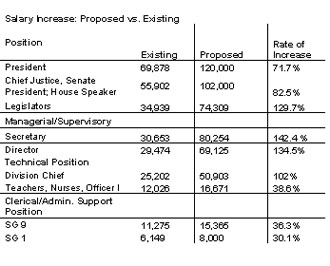
“The Joint Resolution No. 24 or the Salary Standardization Law 3 (SSL 3) of Andaya and Nograles makes the gap between the lowest and highest paid employees even wider. For the Salary Grade 1, Step 1 employees, they only get a measly 30.1 percent increase while those in the higher positions get 100 to 142 percent increases,” he explained.
Among the recipients of the huge percentage of increase are the Chief Executive (President of the Republic) and legislators, aside from department secretaries and undersecretaries, attached and line agency and bureau directors, and division chiefs.
To illustrate, Mr. Gaite provided Bulatlat this table:


#37. bakit yong mga congressmen ba nagpasa nito are all professionals? yong iba nga sa kanila ndi naka-tapos. Pero taas taas ng rate of increase nila who work harder, di ba yong rank in file? gagawin lng ng heads mag-sign after all.
SANA SI GEBO NALANG NAGENG PRESIDENTE. MASUSULOSYONAN PA SANA NYA ANG GANITONG PROBLEMA HUHUHUHUHUHUHUHU KUCK YOU SA MGA BOMOTO SA PRES. NATIN NGAUN. LAM NYUNA NGAUN NA WALANG NAGAWA XA SA GANITONG PROBLEMA. MGA PILIPINO NGA TALAGA, WALANG KA DALA-DALA. AAAAHHHHAAAAAYYYYYY….
This new salary increase is not unfair….not all S1 to S9 are not professional,,some of them are professional and having a career civil exam professional, and then the increase is not fair to everybody..hope u see this situation…thank u
Pingback: Government Employees Call for P6,000 salary hike, Revocation of Executive Order No. 7 - Bulatlat
Pingback: Educators Call On Lawmakers To Increase Teachers’ Salaries - Bulatlat
dapat naman eh yung mga nasa SG1 ang may mas malaking increase kasi sila yung kawawa, kung sino pa yung nasa mataas na position eh sila pa yung may malaking increase, unfair naman. kung tutuusin eh yung mga nasa clerical positions naman ang gumagawa ng halos lahat ng trabaho sa government offices eh.
what are those basis in determining salary grades?
Pingback: Salary Standardization Law III – Wage Increase – Sugod News Philippines
Dapat nagpost sila o nagbigay nga list ng increase sa lahat ng mga employees from higher position to the lower…dapat yung mga laborers ng government…e.g.basurero…janitor dapat higher pay sila…kasi malinis kasi silang nagtatrabaho…What Kind of Government is this?
i am for the salary increases however, let dbm look into more seriously on adding more benefits to those low paid employees not belonging to the technical workers. Give more law to the poor
it seems that the additional provision of the law for the math and science teacher to have a salary of 3 steps higher in their salary grade is not implemented. Can we not ask the civil service to act on this?
this said increase is not at all be considered fair but in the case of just having an additional salary increase for the ordinary workers mas maigi na to kesa sa wala….. we feel the burden pero sana naman pag-isispan ng gobyrerno natin kung anu ang talagang dapat gawin…. kasi sa tingin ko hindi naman sapat na basehan lang ang taas ng salary natin.. but its the worth of products we have(yung value)
SSL 3 willn not ease the financial burden of government employees. The 38 – 50 percent increase in salaries of Lower positions (SG 23 down) is spread over four years, while higher positions starting SG 24- up or Division Chiefs, Directors, ASec, Usecs, Secretary up to the President including Senators and Congressmen will benefit as much as 80 to 150 percent, from SSL 3. Where is justice in this salary pay scheme? Those who received more, with get even more, aside from increased monthly RATA, discretionary allowances, unlimited foreign trips, and honoraria. By the way, how come they are not releasing the matrix of positions and the corresponding salary increases under SSL 3? Why to de have dis impression that they are hiding this from the ran ks of government employees? All government agencies should be furnished with a copy of SSL 3.
SSL 3 is a grave insult to the rank-and file members of the government sector. It legitimizes the whooping increase in the salaries of government officials, and the miniscule increase proposed for rank-and-file state employees. It is is very much lopsided in favor of government officers compared with the pitiful increase in the salaries of lower level employees who are in dire need of a much-needed economic relief. It is also confiscatory since most of the benefits and allowances enjoyed by senior employees will be scrapped to give way to an across-the-board standard set set of benefits and allowances which will not reckon the long years of government service by a a state employee whose best years were spent with the government institution. Besides, the non-transparency and non-consultation with government employees in the deliberations made on SSL 3 is appaling.
I'm jez, really, SSL3 is so unfair.. like me who is holding a position equivalent to SG8.. JESUS, GINOO KO! Why not give a level increase to all rank and file employees and high rank? Looy gyod intawon ang mga gagmay ug sweldo, pila raman ang madugang nga percentage raman ang increase! Maayo pa wala nalang increase, arun walay sakit sa among dughan! GMA, way kasingkasing!
send me the Complete Salary Grade Table of Government Employees here in the Philippines base upon the new Salary Standardization Law III
ssl 3 will somehow uplift the status of the government employees. However, if we are going to base it with the standard of living in the country today, its not enough. Govt employees maybe coping up with private corporation employees but then such increase especially in the lower ranks wont ease the burden.
INYUON NALANG NANG INCREASE! WLAY IKATABANG..MAAYO NA SA MGA DAGKO NA DAAN UG SWELDO..MAKALOLOOY ANG GAGMAY UG SWELDO…UNYA RA BA! TUA SA KADAGKUAN ANG KUSOG MO DAWAT UG SUBORNO..MAAYO JUD! PORYA GABA NINYONG TANAN!!!!!
Uy, nangalabad naman ciguro mo. wa ninyo huna huna a nga ang mga gagmay ug sweldo maoy han-ukan sa trabahuon. unya palamilami ra mo dagko ug sweldo. kamo ray dagko ug increase. ayaw mo palabi inyo gibate uy. kay magabaan baya mo.
HOY! MGA HARAG MONG DAGKO,TAMBALOSLOS MONG TANAN,WA MOY HINUNGDAN NANGLINGKOD DIHA,KANAOG MO SA INYONG POSISYON WA MOY ANGAY, DILI MAKATABANG OG POBRE….
other allowances should be given to all employees not just to those who were hired before december 1999 like the rice allowance, medical & dental..we all know that these are still people who eats rice and is still gets sick specially now that there is this swine flu in our country
can you please furnish me a copy of the matrix for the 2009 salary increase. thanks
This is very unlawful knowing that teachers and nurses spend most of their time servng the citizens of the Philippines. Teachers who are considered the base of knowledge of the country will be receiving an unjust salary increase. Corrupt bastards!
The proposed law is good but apparently lacks the true substance. A mere propaganda for the upcoming election? Come to think of it guys, it actually contradicts the pro poor program of the Arroyo govt. I praise our great leaders especially the Congress for passing this bill but can't we ask a little bit more from them, besides every law should promote the betterment of the Filipino people. A good leader should not only favor the higher ups of the govt or their trusted lieutenant. it will only increase the widening gap of the rich and famous from the poor and oppressed. As a Kapampangan I will be ashamed if our great Mother, the President of the Republic, if she allow these things to materialize. I think it would be a legendary legacy to leave as she bid her farewell. Or as her critics feared this might trigger a catapulting result and rally her as the new Prime Minister of our great country. Lbjr.
send me the Complete Salary Grade Table of Government Employees here in the Philippines base upon the new Salary Standardization Law 3… Thanks..
They said that this law is another benefit for the government employees who are working hard for the government. But we all know that, not all government employees and even officials are being TRUE to their work. There are some of them who just sit inside the office 8-12 1-5 without doing anything, others are just chatting and gossiping. So for me, it would be better if only the DESERVING government employees and officials should be benefited because it this is very unfair for those who are really working hard and receiving an ample salary. They should have required the supervisors (or any person who manages every office/LGU) to submit the list of QUALIFIED and DESERVING government employees/officials who are worth to be benefited.
You should be thankful for the increase. There are people in government who does the same work, if not more, as regular govt personnel but receives the 2001 salary rates. These people are the contract of service personnel. I know a lot of people who does technical work (second level position) but they don't get any overtime pay, promotion, pay raise, or even any allowances. Just imagine how unfortunate these people are. They need the raise as much as the regular personnel needs them, but they don't get any attention at all.
mr julius has a very good point.. lower SGs doesn't mean less work and responsibility these lower SGs attend to.. I am, for example, is SG9, but, gosh! i know almost every one's job in this agency! also, I have this special skill that no one in our office can perform.. they say, i shouldn't be stuck in this agency bcoz of the low pay, my knowledge and abilities are going into waste..I am aiming for a promotion, but still, that vacant position is not yet announced vacant..due to rationalization..so, the rationalization of agencies should also be looked into, so as not to discourage able workers..
The SSL3 is VERY,VERY UNFAIR. I am in the middle salary grade (18) and i honestly believe that those in the lower salary grades (especially 12 and below)are unfairly treated. Do you people honestly believe that lower SG means less work and responsibility? sounds like a joke to me! perhaps in some agencies it holds true. If the salary increases were to be compared to the price increases from prior to salary increases (SSL1), you will notice that so little has improved for those in the lower SGs. It seems that legislators think that only those in the higher SGs are affected by economic forces, like say, inflation. That's stupid thinking. I therefore believe that before any other increases be approved, across the board salary increases should first be implemented. It sounds fairer that way.
If we look at a certain point, we should look closer to see the entire picture. The intention of the SSL3 is to rationalize the rank with its corresponding salary. Meaning, the higher the responsibility/work, the higher the salary… Tantamount in saying, no work no pay or less work, less pay… For those in the rank and file, it is suggested that they strive hard and perform better to get promotion… to reach SG 16 and above, which are already in the technical position but still categorized as rank and file… The SSL3 is fair and motivational to some extent.
we strongly suggest for the reduction of optional retirement age among civilian govt workers from 60 to 55 y.o. we also support the implementation of an early retirement program offered similar to that of the Aquino Administration.
I concur with the suggestion of others that due consideration be given to those occupying salary grade 10 and below. However, let it be noted and be given emphasis that compensation scheme be likewise be in accordance with the constitutionally-provided MERIT SYSTEM. That would mean that increases in salary, for that matter, among different levels of government employees, CANNOT and SHOULD NOT be equal, rather, those positions requiring special skills of professionals and the like must receive higher percentage-increase. To do otherwise would be a slap to our MERIT SYSTEM..
whenever we asked for increase, they its not allowed, thats fine with as actually for 4 years, but some of the foreign assisted project staff is getting higher than us while the position and the terms of reference are the same. they say because that project is a grant and we are on loan project, i dont think thats fair. the grant project staff is getting even more than an organic personnel, how is that possible that DBM is not acting on it. again the agency i am now will tell me because they are grant. Well, anyway…whatever
what about those Project Contractual staff who's salary is drawn from MOOE, and who's was hummered and nailed from the starting salary, no benefit, no incentives, none whatsoever. Also, i just hope the DBM would standardize the salary of all Project Management Offices in all agencies, whether the project is grant or loan, still its a government money anyway.
where's the matrix of all salary grades of the proposed salary standardization law 3? please provide us. tnks.
I am in favor of the comments made by Eufrenia, i just hope that we that belongs to the salary grade 10 down will have a hihger percentage rate of salary increase than those of higher ranks.
please provide us the matrix of all salary grades for the salary standardization Law 3
Please display the matrix of all salary grades of the proposed salary standardization 3
I just come to browse on DBM issuances,and related info on SSLIII,truly such increase especially among the rank abnd file employees like teachers is very small and if implemented,those who are in the top ranks are more benefited that those in the lower rank. If I may suggest, The arroyo gov't would rather grant higher pecentage of salary increase to salary grades 1 to 10,and lower percentage increase to those from salary grades 11 up to insure a more just and humane distribution of salary increases.It's true that with the proposed increase those from SG 1 to 10 will still have a big difference from those with SG 11 and up.The Philippines has much money, why can't the rich share what they have?