
The AFP is currently implementing a five-year Philippine Defense Reform (PDR) program under the supervision of the U.S. Pacific Command. This program was an offshoot of a Joint Defense Assessment conducted by U.S. defense “experts” that looked into the capabilities of the AFP in combating “terrorism.” It was a three-year assessment that was completed in 2003. This program is aimed at enhancing the capabilities of the AFP in line with the U.S. thrust of strengthening its surrogate armies. More importantly, with “significant American involvement in monitoring its implementation,”[19] the PDR gave the U.S. strategic and tactical control over the planning and operations of the AFP.
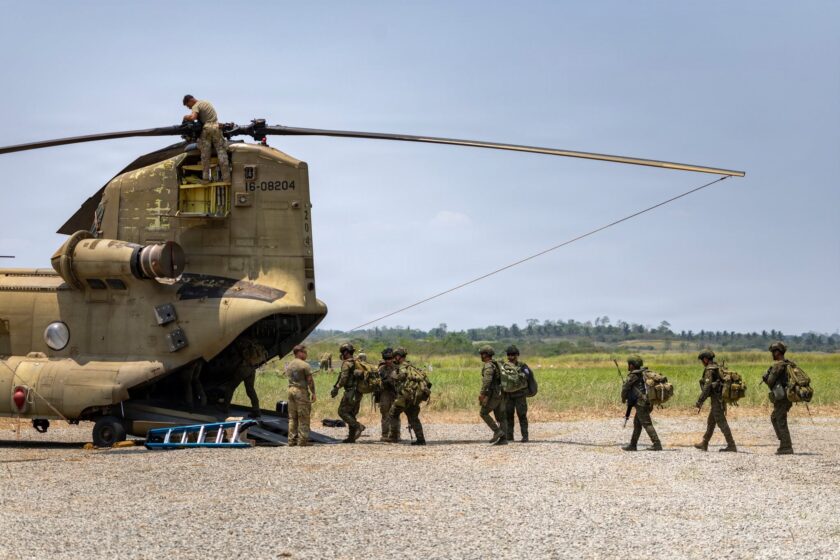
The joint exercises and other trainings conducted by the U.S. are also aimed at improving the capacity of the U.S. and Philippine armed forces to conduct joint operations under the former’s command and direction; improve the capability of the AFP in waging wars against the perceived enemies of the U.S. and its local puppets; and contribute to the combat experience of U.S. troops, another objective of the 2006 QDR.
Right from the start of the U.S. “global war on terror” and the planning for Balikatan 2002, President Bush had already offered that U.S. troops be sent for combat patrols in Mindanao. If not for the opposition of people’s organizations and former Vice President Teofisto Guingona, the U.S. would have had its way. But an international fact finding mission conducted in Basilan in 2002 confirmed earlier reports that U.S. troops were engaged in a fire fight with Abu Sayyaf forces in June. The mission report revealed that an American soldier in a raiding unit with a specific combat mission to arrest an Abu Sayyaf suspect had shot that suspect in the leg.
In early 2003, the U.S. proposed that the joint exercises be moved to Jolo and that the role of its troops be upgraded to enable them to engage the Abu Sayyaf.[20] But again protests by people’s organizations forced the U.S. and Philippine governments to officially shelf the planned shift.
As if to make the direct involvement of U.S. troops palatable, Mindanao was rocked by a series of bombings in 2003. Bombs exploded at the airport and Sasa Wharf in Davao City and in Koronadal City. A total of 47 people were killed and 208 wounded. The Philippine government was quick to claim that the bombings were the handiwork of terrorists.
But a group junior officers of the AFP who holed themselves up at Makati in July 2003 as a sign of protest revealed that some of them were commanded to do the bombings by senior military officers. They also reported that right before the bombings then Philippine Defense Secretary Angelo Reyes and Brig. Gen. Victor Corpuz, who was then chief of the Intelligence Service of the Armed Forces of the Philippines (ISAFP), were in Davao.
Another incident seems to have pointed to the involvement of the U.S. in the bombing. In May 2002, a bomb exploded in a hotel room in Davao. The victim and handler of the bomb, an American by the name of Michael Meiring was spirited out of the country three days later by the U.S. Federal Bureau of Investigation even before investigations started. There were suspicions that Meiring was a CIA agent. Meiring referred to himself as a CIA agent but always clarified that he meant “Christ in Action.”
Other bombing incidents occurred in 2004 and 2005 killing 147 and 10 people respectively and wounding 200 others.
In July 2005, U.S. and Filipino troops reportedly launched a joint combat operation in pursuit of Abu Sayyaf leader Khadaffy Janjalani. When human rights and people’s organizations protested against this blatant form of U.S. intervention, a U.S. military official denied this but acknowledged that U.S. Special Forces and Navy SEALS were working in the area with Filipino soldiers supplying communications and intelligence support. U.S. Navy P3 Orion aircraft were reportedly used for intelligence operations.[21]
Why then is the U.S. so keen in joining Filipino troops in combat operations against the Abu Sayyaf when the latter is hardly a threat to the Philippine government much less the U.S.?
The planning and conduct of Balikatan joint exercises, or more precisely joint operations, is consistent with how the U.S. is trying to shape its armed forces and military capabilities. These are contained in the major the shifts in thrusts identified by the 2006 QDR. Among the shifts in capabilities the U.S. aims to develop in its forces are:
*from static defense, garrison forces – to mobile, expeditionary operations
*from under-resourced stand-by forces – to fully-equipped and fully-manned combat forces
*from battle-ready forces – to battle hardened forces
*from large institutional forces – to more powerful operational capability
*from major conventional combat operations – to multiple, irregular asymmetric operations
*from the U.S. military performing tasks – to focus on building partner capabilities
These training exercises and the continuing presence of U.S. troops in Mindanao also enable it to gain a foothold in resource-rich Mindanao. To further strengthen its stake in Mindanao, the U.S. is actively involved in the peace talks between the government and the MILF. In addition, between 2001-2005, the U.S. Agency for International Development provided $220 million, or 60 percent of its total assistance to the Philippines, to Mindanao.[22] For 2006-2007, the U.S. is preparing an increased assistance package to Mindanao in anticipation of the signing of a peace accord between the Arroyo government and the MILF.
——————————————————
[1] The United States Security Strategy for the East Asia Pacific Region, 1998
[2] Gary Leupp, “The Philippines: Second Front in the U.S.’s Global War,” Counterpunch, February 21, 2002
[3] Aziz Choudry, “Colonial Comeback,” Third World Traveler, Spring 2003
[4] John H. Noer, “Chokepoints: Maritime Economic Concerns in Southeast Asia,” Washington, D.C., National Defense University, 1996
[5] U.S. Department of Commerce, “Statistical Abstract of the United States,” no. 1323, 1998, p.801
[6] U.S. Department of Commerce, Bureau of Economic Analysts, “ Survey of Current Business,” July, 1998, Table 3.2
[7] Asia Trade Hub.com
[8] World Pipelines, “Regional Briefing: Southeast Asia”
[9] Congressional Research Service, “Terrorism in Southeast Asia,” December 13, 2002
[10] Angel M. Rabasa, “Southeast Asia: The Second Front?”, Fighting Terrorism on the Southeast Asian Front, Asia Program Special Report, June 2003
[11] Philip Bowring, “Stretching the ‘War on Terror’”, Global Policy Forum, August 14, 2002
[12] Ibid
[13] Congressional Research Service, “Terrorism in Southeast Asia,” December 13, 2002
[14] Murray Hutton, “Second Front in the War on Terror: U.S. Military Bacdk in the Philippines with a Vengeance.”
[15] Testimony by Catharin E. Dalpino, “Terrorism and Separatism in the Philippines : Distinctions and Options for U.S. Policy,” to the Sub-committee on East Asia and the Pacific, House International Relations Committee, U.S. Congress, June 10, 2003
[16] Ibid
[17] Murray Hutton, “Second Front in the War on Terror: U.S. Military Bacdk in the Philippines with a Vengeance.”
[18] James Reilly, “U.S. ‘War on Terror’ and East Asia,” Foreign Policy in Focus, February 2002
[19] Carl Baker, “The Philippines and the United States 2004-2005: Defining Maturity,” Asia Pacific Center for Security Studies, February 2005
[20] Testimony by Catharin E. Dalpino, “Terrorism and Separatism in the Philippines : Distinctions and Options for U.S. Policy,” to the Sub-committee on East Asia and the Pacific, House International Relations Committee, U.S. Congress, June 10, 2003
[21] Andrew Feickert, “U.S. Military Operations in the Global War on Terrorism: Afghanistan, Africa, the Philippines, and Colombia,” CRS Report for Congress, August 2005.
[22] Embassy of the United States of America, “Securing Peace in Mindanao through Diplomacy, Development, and Defense.”
 Save as PDF



0 Comments